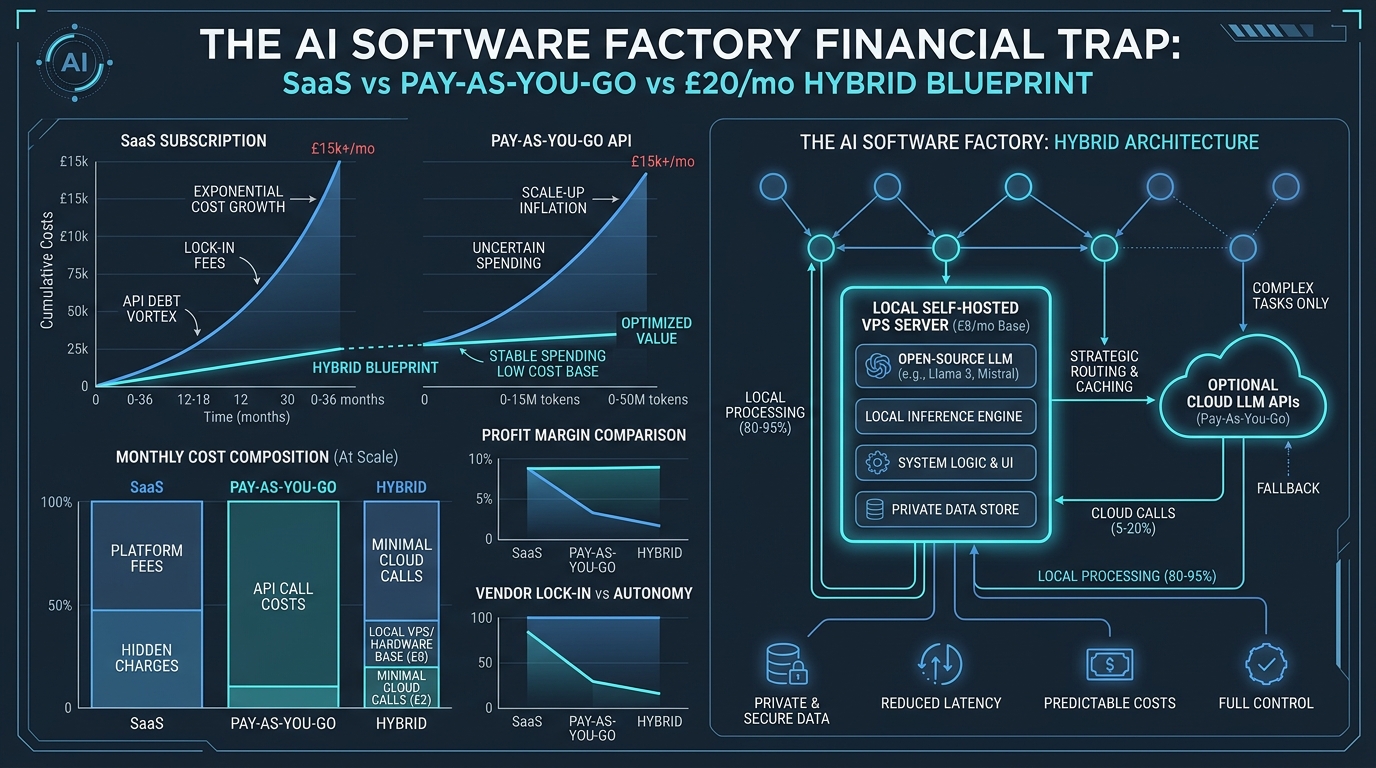
Whitepaper Callout: Download the Full Architecture PDF Whitepaper
1. Introduction: The $200+/Month Developer Subscription Trap
If you're a software engineer, freelancer, or technical founder in 2026, take a look at your monthly credit card statement. You're likely paying for a stack of flat-rate AI tool subscriptions:
- Cursor Pro / Copilot Workspace: $20 - $40/month
- Claude Pro / ChatGPT Plus: $20 - $50/month
- Specialized AI Coding Assistants: $30 - $60/month
- Uncapped API Overage Fees: $100 - $300+/month
Before you know it, you're spending $200 to $500+ every single month just to keep your AI development tools running.
                   THE SUBSCRIPTION STACK SQUEEZE
  +------------------------------------------------------------------+
  | Cursor / Copilot ($20-$40) + Claude Pro ($20) + ChatGPT ($20)    |
  | + API Overages ($150+) = $210 - $500+/mo per dev                  |
  +------------------------------------------------------------------+
                                   |
                                   v
  +------------------------------------------------------------------+
  |  RESULT: Rate limits, throttled background agents, giant bills  |
  +------------------------------------------------------------------+
The Rate Limit Ceiling
Even worse, flat-rate SaaS seats aren't built for modern autonomous agent loops. The second you run an agent workflow (like refactoring an entire module, generating unit tests, or running Open Claw background tasks), your agent executes dozens of file reads, AST checks, and prompt iterations.
Within 20 to 30 minutes of heavy agent work, you hit your hourly rate limit cap. You're paying hundreds of dollars a month, yet you're constantly forced to pause work while waiting for quota resets.
2. The Solution: The Home Hardware AI Software Factory
Instead of paying multi-thousand-pound monthly cloud API bills or five redundant SaaS seats, we repurpose hardware sitting on our desks into a distributed, high-productivity AI Software Factory.
             THE DISTRIBUTED HOME HARDWARE SOFTWARE FACTORY

  +------------------------------------------------------------------+
  |  1. MacBook Pro 64GB M1 Max (Primary Heavyweight Inference)       |
  |     - Runs Qwen 2.5 Coder 32B / DeepSeek R1 via Ollama (£0/mo)   |
  |     - Orchestrates Open Claw autonomous agent loops              |
  +------------------------------------------------------------------+
                                   |
  +------------------------------------------------------------------+
  |  2. HP Desktop i7 (24GB RAM) (Build & Test Execution Server)     |
  |     - Isolated Docker build node, static analysis, Vitest runner  |
  |     - Vector database & AST indexing cache                       |
  +------------------------------------------------------------------+
                                   |
  +------------------------------------------------------------------+
  |  3. Raspberry Pi 5 + Mini Display (Telemetry & Control Deck)    |
  |     - Real-time physical dashboard for queue & token throughput  |
  |     - Live cost tracking & model fallback alerts                 |
  +------------------------------------------------------------------+
                                   |
  +------------------------------------------------------------------+
  |  4. Targeted Pay-As-You-Go API Keys (Cloud Escalation)           |
  |     - Gemini 1.5 Flash (Bulk context & long prompts)             |
  |     - Claude Code / Sonnet (Deep architecture & complex logic)   |
  +------------------------------------------------------------------+
3. Hardware Roles & Responsibilities
1. MacBook Pro 64GB M1 Max (Heavy Inference & Agent Engine)
With 64GB of Unified Memory, the M1 Max chip acts as the brain of the factory. It loads 32-billion parameter coding models (like qwen2.5-coder:32b) entirely into GPU memory, serving 40-60 tokens/second at $0 in variable token fees. It runs the Open Claw orchestrator to assign sub-tasks.
2. HP Desktop i7 with 24GB RAM (Dedicated Build & Testing Rig)
Running heavy agent loops directly on your main laptop can drain battery and slow down your IDE. The HP i7 desktop offloads all heavy non-LLM operations:
- Executing isolated Docker test containers
- Running
vitest/pytestsuites and AST static analyzers - Hosting a local vector database for fast codebase indexing
3. Raspberry Pi 5 + Mini Display (Physical Control Deck)
Mounted on your desk, the Pi 5 acts as a dedicated monitoring HUD. Connected to a mini HDMI display, it runs a custom status dashboard showing:
- Real-time token processing speed (tokens/sec)
- Daily API cost accumulator (staying under target budget)
- Active background agent task queues and build status indicators
4. The Cloud API Safety Net: Gemini & Claude Code
For edge cases that exceed local model capability, the factory escalates to pay-as-you-go cloud APIs:
- Gemini 1.5 Flash API Keys: Used for bulk codebase context ingestion and long-document processing at pennies per million tokens.
- Claude Code / Sonnet API Keys: Reserved strictly for high-ambiguity system redesigns and complex root-cause debugging.
Because Claude is called only when local Mac models hit a verified test failure, your Anthropic API bill drops from $200+/mo down to $5 - $10/month.
5. Cost Comparison: $200+/mo SaaS vs Home Hardware Factory
| Metric | SaaS Seat Stack | Home Hardware Software Factory |
|---|---|---|
| Monthly Cost | $200.00 - $500.00+/mo | $10.00 - $20.00/mo (API overages) |
| Inference Hardware | 3rd Party Cloud | MacBook Pro 64GB M1 Max (Local) |
| Build & Test Isolation | Local laptop CPU (Slow) | Dedicated HP i7 Worker Node (24GB) |
| Telemetry & HUD | Web browser tabs | Raspberry Pi 5 Mini Display (Physical) |
| Rate Limit Cap | Severe (Hits cap in 20m) | Zero (Local processing is uncapped) |
6. Summary & Part 2 Teaser
By orchestrating your MacBook Pro 64GB M1 Max, HP i7 Desktop, Raspberry Pi 5, and targeted API keys, you create a self-contained AI Software Factory that operates 24/7 for a fraction of traditional SaaS costs.
In Part 2: Hardware Setup, Open Claw & Smart Routing, we walk through:
- Configuring Open Claw to dispatch tasks across your Mac, HP desktop, and Pi 5
- Setting up Ollama model weights for 64GB unified memory
- Live interactive cost router simulator
Whitepaper Callout: Download the Full Architecture PDF Whitepaper