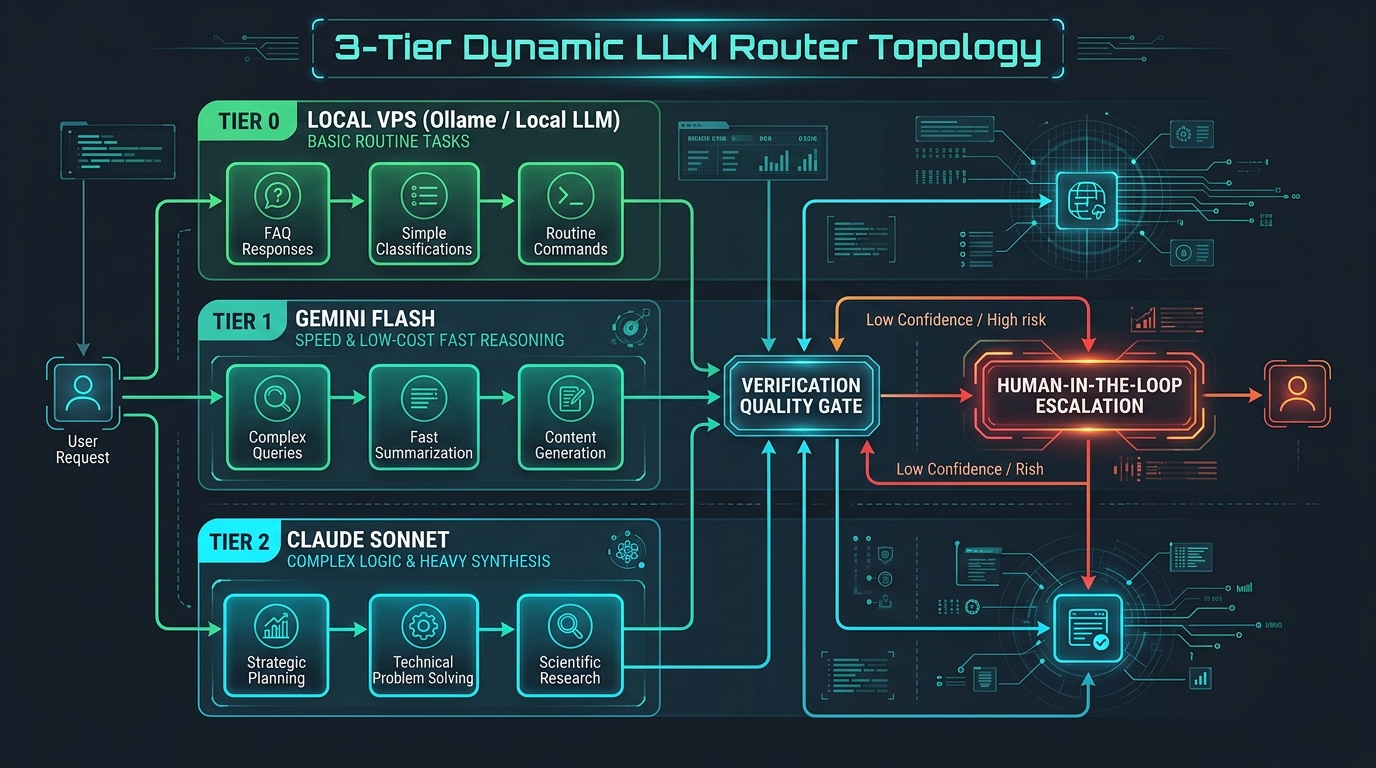
Whitepaper Callout: Download the Full Architecture PDF Whitepaper
1. Practical Setup: Orchestrating the Hardware Stack
In Part 1: Slashing $200+/mo Subscriptions with a Home Setup, we outlined how to combine a MacBook Pro 64GB M1 Max, an HP i7 Desktop, a Raspberry Pi 5 with Mini Display, and pay-as-you-go API keys into a $0-variable-cost development engine.
Now, let's walk through the exact setup and configuration to bring this factory online with Open Claw and Agent Skills.
                   FACTORY WORKFLOW & TASK DISPATCH

   [Developer / Agent Task]
              |
              v
   +-------------------------------------------------------+
   |  MacBook Pro 64GB M1 Max                              |
   |  - Open Claw Orchestrator                             |
   |  - Custom Agent Skills Directory (.agents/skills/)    |
   |  - Ollama: Qwen 2.5 Coder 32B (Local LLM Inference)  |
   +---------------------------+---------------------------+
                               |
               +---------------+---------------+
               |                               |
               v                               v
   +-----------------------+       +-----------------------+
   |  HP i7 Desktop        |       | Raspberry Pi 5 HUD    |
   |  (24GB RAM)           |       | (Mini Display Dashboard|
   |  - Docker Test Runner |       | - Live Token Stream   |
   |  - Vitest / Pytest    |       | - Cost Meter          |
   |  - AST Analyzer       |       | - Task Status         |
   +-----------+-----------+       +-----------------------+
               |
               v (Test Fails?)
   +-------------------------------------------------------+
   |  Cloud API Escalation Layer                           |
   |  - Gemini 1.5 Flash (Bulk context)                    |
   |  - Claude Code / Sonnet (Complex reasoning)          |
   +-------------------------------------------------------+
2. Supercharging Local LLMs with Agent Skills (SKILL.md)
How do smaller, local open-weights models (like Qwen 2.5 Coder 32B running on your Mac) achieve senior-developer quality without burning money on cloud frontier APIs?
The answer lies in Agent Skills—modular, context-rich instruction bundles stored in .agents/skills/<skill-name>/SKILL.md.
                         THE AGENT SKILL STRUCTURE

  .agents/
  └── skills/
      ├── unit-testing/
      │   ├── SKILL.md            <-- YAML Frontmatter + Procedural Rules
      │   └── references/         <-- Schema definitions & past examples
      ├── database-migration/
      │   └── SKILL.md
      └── git-workflow/
          └── SKILL.md
Why Agent Skills Drive Down Costs
- Eliminates General Reasoning Overhead: Instead of expecting a model to guess your team's specific coding style, AST preferences, or deployment pipeline, the
SKILL.mdfile provides explicit procedural constraints. - Leveling Up Local Models: A 32B local model reading a targeted
SKILL.mdinstruction file will outperform an unguided 1-trillion parameter model on specialized tasks—costing £0.00. - Zero Token Waste: Skills are lazily loaded into agent context only when relevant triggers are detected in a task, preserving context windows and keeping token costs at zero.
Example SKILL.md Definition
---
name: unit-testing-suite
description: Best practices for writing Vitest unit tests for Next.js and TypeScript APIs
---

# Unit Testing Skill Instructions

1. Always use AAA pattern (Arrange, Act, Assert).
2. Mock external database calls using `vi.mock("@/lib/firebase")`.
3. Ensure 100% boundary check coverage for null and undefined inputs.
3. Step-by-Step Hardware & Open Claw Configuration
Step 1: Configure MacBook Pro 64GB M1 Max (Primary LLM Engine)
Install Ollama and pull the 32B parameter coding model. With 64GB of unified memory, allocating ~20GB to GPU VRAM allows full 32B 4-bit quantized execution at zero lag:
# Pull 32B coding model optimized for Apple Silicon 64GB
ollama pull qwen2.5-coder:32b

# Verify GPU unified memory execution
ollama run qwen2.5-coder:32b "Implement a resilient retry handler in TypeScript"
Step 2: Configure HP i7 Desktop (Build & Testing Node)
On your HP Desktop (running Ubuntu/Debian Linux with 24GB RAM), launch the local test execution server:
# Clone project repository and spin up Docker runner worker
git clone https://github.com/your-username/software-factory-worker.git
cd software-factory-worker

# Run automated build & test listener on HP desktop
npm run start:test-worker -- --port=9090
Step 3: Configure Raspberry Pi 5 Mini Display HUD
On the Pi 5 connected to its mini HDMI display, run the lightweight status dashboard:
# Launch physical telemetry dashboard on Pi 5
python3 telemetry_hud.py --mac-host=192.168.1.150 --display=mini
4. Configuring Open Claw Routing & Escalation
In your Open Claw config (claw.config.json), configure your local Mac LLM as primary, the HP desktop for test validation, and cloud APIs for fallbacks:
{
  "hardware": {
    "primary_llm_node": "http://localhost:11434",
    "test_runner_node": "http://hp-desktop.local:9090",
    "telemetry_hud_node": "http://pi5-display.local:8080"
  },
  "skills_directory": ".agents/skills",
  "routing": {
    "tier0_local": {
      "provider": "ollama",
      "model": "qwen2.5-coder:32b",
      "cost_per_1m": 0.00
    },
    "tier1_flash": {
      "provider": "gemini",
      "model": "gemini-1.5-flash",
      "cost_per_1m": 0.075,
      "api_key": "${GEMINI_API_KEY}"
    },
    "tier2_frontier": {
      "provider": "anthropic",
      "model": "claude-3-5-sonnet-20241022",
      "cost_per_1m": 3.00,
      "api_key": "${ANTHROPIC_API_KEY}"
    }
  }
}
5. Interactive Cost Calculator
Simulate how shifting 80%+ of your agent workload to your MacBook Pro 64GB M1 Max slashes your monthly spend compared to $200+/month SaaS subscriptions:
<InteractiveLLMRouter />6. The Hardware Quality Loop
                       HARDWARE QUALITY VERIFICATION LOOP

  1. Prompt + Skill -> MacBook Pro 64GB (Qwen 2.5 Coder 32B generates code)
                            |
                            v
  2. Payload -> Sent over local LAN to HP i7 Desktop
                            |
                            +---> Runs Vitest / ESLint in isolated Docker container
                            |
                            +---> (Pass?) ---> ✅ Commit & Send Telemetry signal to Pi 5 HUD
                            |
                            +---> (Fail x2?) ---> Escalate to Gemini Flash / Claude Code
7. Conclusion & PDF Download
By orchestrating a MacBook Pro 64GB M1 Max, an HP i7 Desktop, a Raspberry Pi 5, custom Agent Skills, and pay-as-you-go API keys, you create a self-contained AI Software Factory running for under $15/month.
Whitepaper Callout: Download the Full Architecture PDF Whitepaper
Dynamic LLM Router & Cost Simulator
£20/Month AI Software Factory Tiered Intelligence Benchmark📊 Workload Parameters
🔀 Tier Allocation Ratios
Auto-normalized to 100%💳 Monthly Cost Comparison
100% of tasks routed directly to Claude 3.5 Sonnet ($3.00/1M in, $15.00/1M out).
Fixed license fee of $40/seat/month across 5 developer seats.
£13.00 Local VPS + £0.74 Flash API + £11.25 Sonnet API
📈 Relative Monthly Cost Visual Chart
🧪 Prompt Test Preset Selector
Click a preset below or type a custom prompt to test how the dynamic LLM router evaluates complexity and routes prompts across Intelligence Tiers.